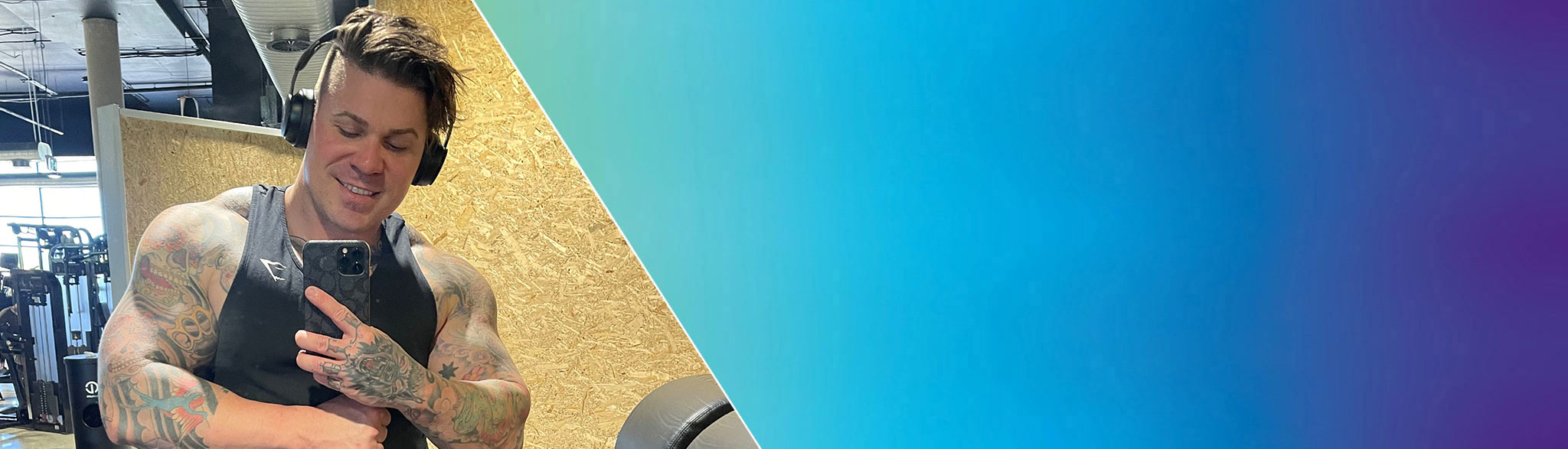
Nick’s Story
With spinal cord stimulation
Nick can now see a future helping veterans like himself
In 2017, Nick Hunt (32) was in the army on a training exercise in Victoria when a trench collapsed and he suffered injuries to his back and leg that would change the course of his life.
“My body thought my leg was broken”
Whilst on exercise and digging trenches at 2am, a trench gave way and Nick fell, he was carrying a pack weighing 60-65 kilograms. His body collapsed ‘like an accordion’ and he injured his back and his ankle.
Nick realised that something was very wrong when he took his boot off and saw his leg had turned black from the shin down. He had ruptured some of the connective tissues in his lower leg and required surgery. Since this initial injury Nick has had 5 major surgeries.
After his first surgery Nick was doing well with rehabilitation but was put back onto active duties too quickly. “It was after about 4 months of rehab, when it usually takes 9 months,” he said.
A short time later Nick’s ankle was badly injured again requiring further, more invasive, surgery. The pain in Nick’s back began around the time of his second ankle operation.
“Looking back, I think everyone was so focused on the ankle that they didn’t realise that my back was stuffed,” said Nick, “I was either in a moon boot, a cast or on crutches for about 52 weeks out of two years.”
After being reinjured again, and having a third ankle reconstruction he returned to work but despite successful surgery and a full rehabilitation period, the problems were far from over.
“I was having really bad sympathetic pain reactions, I would wake up and my leg would be swollen so much I would not be able to walk, my body thought my leg and back were broken again,” Nick explained.
It took about two years for Nick to be referred to a Specialist Pain Medicine Physician who diagnosed him with Chronic Regional Pain Syndrome (CRPS), a neurological condition that usually occurs after an injury and results in the nervous system becoming over-sensitised. This causes significant disability and pain. CRPS affects 1 in every 3,800 Australians each year.
Eventually Nick left the army via a medical discharge so he could focus on rehabilitation.
The impact of chronic pain
is mental as well as physical
In the army Nick’s duties were very physical, he would carry 80 kilograms or more on exercise, as well as bodybuilding training in the gym. He said the initial accident took a big toll on his physical and mental health.
“I was young and very fit, prior to the army I had never had an injury, the worst was a broken collarbone when I was 15,” Nick explained.
After developing CRPS Nick could only walk about 50-100m per day. His pain level was 8-9 out of 10 and he was taking high doses of opioid medications to get through the day.
“It’s demoralising. It takes a toll physically, you’re always in pain and you can’t figure out why. At the same time, you’re having to take medications to try and stem it, which then ultimately makes you less motivated and then it’s harder to break that cycle.
I’m a big guy, I go to the gym, I’m covered in tattoos so I get judged on how I look. I had two and a half years walking with a severe limp. Not being able to walk properly and not wanting to socially interact was affecting a lot of things. Relationships would fall apart, people couldn’t understand why I was so miserable.”
The right doctor
and the right treatment
Shortly after Nick received his CRPS diagnosis his pain specialist recommended he try spinal cord stimulation. He completed a trial of the therapy which significantly reduced his pain.
Spinal cord stimulation uses leads placed surgically in the spine that attach to a device called an Implantable Pulse Generator (IPG) which is implanted under the skin. The IPG, through the leads, delivers electrical pulses that disrupt the pain signals to the brain and the therapy is controlled by the patient using an Apple iPod controller, or an app on their smartphone.
Nick received his permanent implant in January 2021 and says it has had a big impact on his life:
“Since I’ve had the implant, my mental health has dramatically improved. My quality of life is better, which is awesome.
Pre-surgery, I was limited to about 50 metres a day of walking, that’s a couple of trips to the fridge and back. Now I can get out and go for a walk and enjoy the sunshine, and return to the gym and train.
If I train too hard one day, I might have a flare up of the CRPS and then I’ve got to mitigate it with medication and changing the frequency on the device, but it’s doable.
I haven’t taken any pain medication for about three and a half months, which is massive for me, considering at one stage I was taking class 6 opioid pain medication twice a day.”
A new focus
in life
Nick moved to the Gold Coast after he had his permanent implant but is still able to be treated by his pain specialist in Canberra using NeuroSphereTM Virtual Clinic. This new technology allows his doctor to connect to his device remotely during a video consultation and make any adjustments if needed.
He said; “The virtual clinic came live probably a month before I left Canberra, which was fantastic.”
Nick says his army training has also helped him take a disciplined approach to tackling the huge challenges he has faced.
“The army helps you realise your potential. My goal was to be the best at what I was doing, and it still is. I know the better state of mind I’m in, the better my body is, the easier it is on the people around me, that’s a big thing for me.”
“My whole life focus has changed a lot. The Department of Veterans Affairs has supported me to go back to university, so I’m studying occupational therapy at Griffith at the moment. Leaving the army was bad as that was a job I wanted to do for the rest of my life, but I was given support due to being injured. I have the ability now to focus on rehabilitation and study, and potentially return to work.
I spent two and a bit years over my seven year career doing rehabilitation, which sucks, but it let me see the plethora of injuries that occur in the army because when you’re in the rehab platoon, everyone is injured. So, it ranges from broken toes, broken fingers, all the way up to dual knee replacements and hip replacements. I realised what needed to be done to take care of soldiers once they were injured.”
One of Nick’s therapy team suggested he use this knowledge and passion to study occupational therapy and ultimately help other veterans. He also volunteers as the local RSL.
“I go in there and chat with veterans from Vietnam, Afghanistan and Iraq and speak about what they can do to potentially fix their injuries or claim some lost wages that they might be entitled to.
I know it’s corny, but I live every day now like it’s potentially my last, because I’ve been through hell and back.”
Now living with his partner and stepson, and close to other family on the Gold Coast, Nick hopes his story will inspire others to get the help they need.